
Your cart is currently empty.


Revolutionizing Pediatric Healthcare Through Educational and Realistic Medical Toys
We equip healthcare providers and caregivers with tools that allow children to learn about and process their medical experiences through play. We have had countless anecdotal reports about these toys reducing fear and increasing cooperation, so we conducted a survey in 2024 to obtain measurable data.
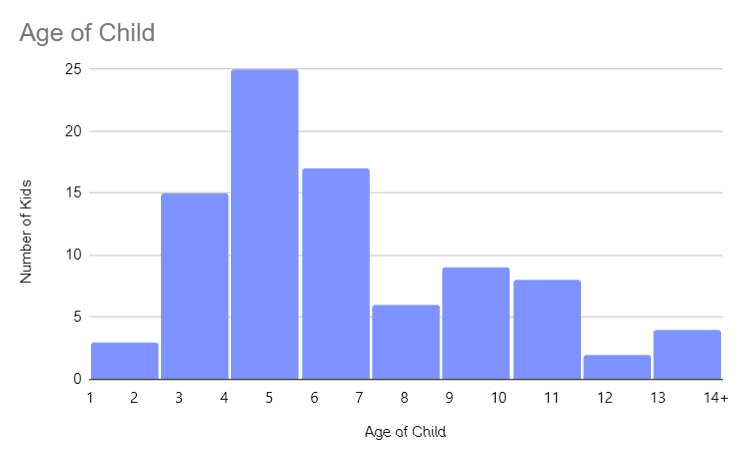
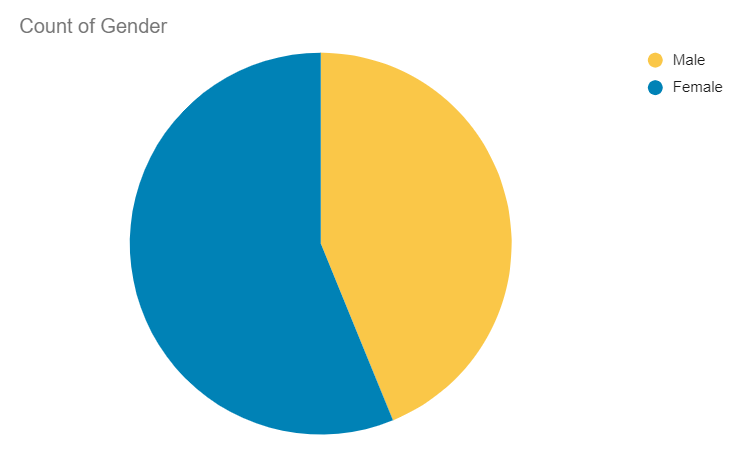
We provided anonymous pre and post questionnaires to 90 parents and healthcare professionals across 22 different hospitals to assess measurable benefits of The Butterfly Pig medical toys in the hospital setting.
The questionnaires utilized 10-point Likert-style rating scales and optional open-ended feedback responses.
The survey was completely voluntary, and results reflect perceptions from families and staff before and after using our medical play tools. This pilot was not randomized, controlled, or designed to prove causation - but the responses help us understand how these tools support child-centered care in real-world hospital settings.
*There is potential for response bias due to the nature of these novel (and adorable) products causing joy and positive feelings in an otherwise clinical environment.
Parents reported perceived anxiety of their child on a scale of 1 to 10 before and after toy use.
The perceived anxiety levels reduced by an average of 40%, and up to 90%
This aligns with broader literature on medical play and age-appropriate preparation.
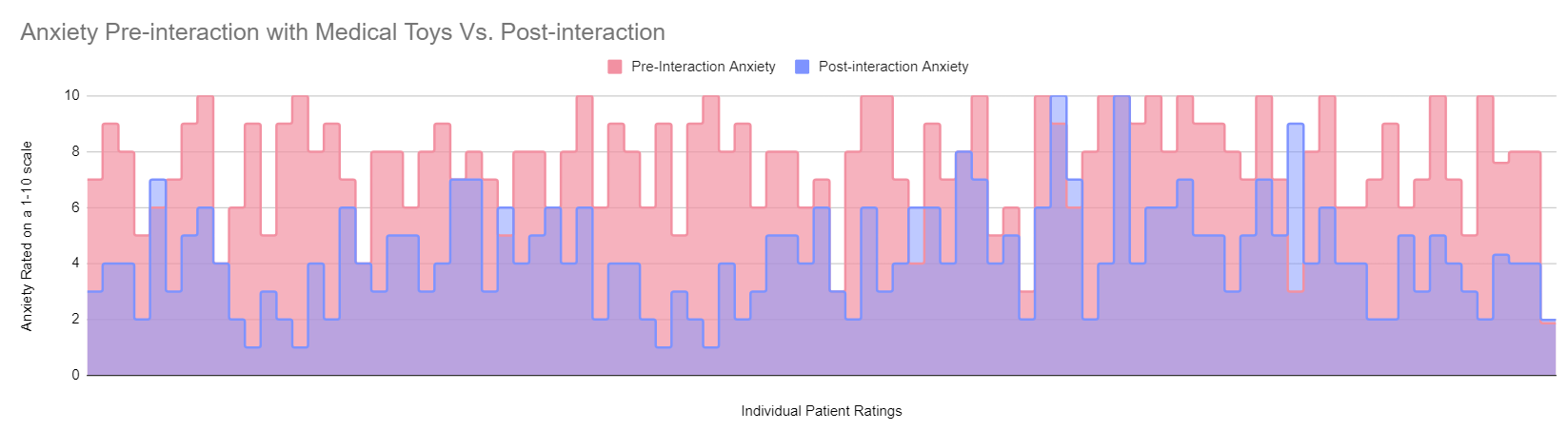
In rare instances where anxiety increased after interaction, those patients also had a significant increase in understanding – so the lack of initial anxiety could likely be related to not understanding upcoming procedures.
Did you notice any positive changes in your child’s recovery process due to the toy medical device(s)? 1 (not at all) - 10 (absolutely)
Average: 8.25

Parents rated the efficacy of the toy medical devices in enhancing their child's understanding of their diagnosis or procedure at an 8.9/10 on average.
(1 being not effective - 10 being extremely effective)
That data was not surprising considering that we also measured preferred learning method, with 80+% reporting doing and seeing as their best method, with their worst learning methods being listening and reading.
This is important because the vast majority of current patient education is presented verbally or through handouts!
How would you rate current resources available to you for pediatric patient education in medical care; specifically for children that learn best by DOING (hands-on interaction). 1 (Very lacking) – 10 (Abundant)
Average: 5.14
How would you rate resources available to you for pediatric patient education in medical care now INCLUDING the use of these custom medical toys. 1 (Very lacking) – 10 (Abundant)
Average: 8.23
How frequently do you find yourself spending extra time on pediatric patient care due to their fear or anxiety around medical procedures? 1 (Not at all) – 10 (Constantly)
Average: 8.25
How did these toys impact your time efficiency in providing child-centered education and care? 1 (Not at all helpful) – 10 (Extremely helpful)
Average: 8.23
Q“Being able to have the supplies readily available made my intervention that much more impactful as I was able to use medical play when requested vs. spending time creating materials + missing my window.”
1 (Not at all) – 10 (Absolutely)Average: 8.25
Q"The toys helped desensitize the patient to the echo machine. Previously she had a lot of anticipatory anxiety witth echos. Since getting the echocardiogram toy, she uses it to play with barbies + even uses it during her own echoes.”
1 (Not at all) – 10 (Absolutely)Average: 8.25
Parents rated the benefit of these tools in their own participation in their child's preparation for upcoming medical procedures at 8.8/10 on average.

Sample size of 90 pediatric patients across 22 different hospitals.
Blount, R. L., Piira, T., Cohen, L. L., & Cheng, P. S. (2006). Pediatric procedural pain.Behavior Modification, 30(1), 24–49.https://doi.org/10.1177/0145445505282438
Coyne, I. (2015). Families and health-care professionals’ perspectives and expectations of family-centred care: Hidden expectations and unclear roles. Health Expectations, 18(5), 796–808. https://doi.org/10.1111/hex.12104
Kain, Z. N., Mayes, L. C., O’Connor, T. Z., & Cicchetti, D. V. (1996). Preoperative anxiety in children: Predictors and outcomes. Archives of Pediatrics & Adolescent Medicine, 150(12), 1238–1245. https://doi.org/10.1001/archpedi.1996.02170370016002
Li, H. C. W., & Lopez, V. (2008). Effectiveness and appropriateness of therapeutic play intervention in preparing children for surgery: A randomized controlled trial study. Journal for Specialists in Pediatric Nursing, 13(2), 63–73. https://doi.org/10.1111/j.1744-6155.2008.00138.x
Li, W. H. C., Chung, J. O. K., Ho, K. Y., & Kwok, B. M. C. (2016). Play interventions to reduce anxiety and negative emotions in hospitalized children. BMC Pediatrics, 16, 36. https://doi.org/10.1186/s12887-016-0570-5
McGrath, P. A. (1994). Psychological aspects of pain perception. Archives of Oral Biology, 39(Suppl.), S55–S62. https://doi.org/10.1016/0003-9969(94)90189-9
Perry, J. N., Hooper, V. D., & Masiongale, J. (2012). Reduction of preoperative anxiety in pediatric surgery patients using age-appropriate teaching interventions. Journal of PeriAnesthesia Nursing, 27(2), 69–81. https://doi.org/10.1016/j.jopan.2012.01.003
Rodriguez, C. M., Clough, V., Gowda, A. S., & Tucker, M. C. (2012). Multimethod assessment of children’s distress during noninvasive outpatient medical procedures: Child and parent attitudes and factors. Journal of Pediatric Psychology, 37(5), 557–566. https://doi.org/10.1093/jpepsy/jss005
Svendsen, E. J., Pedersen, R., Moen, A., & Bjørk, I. T. (2017). Exploring perspectives on restraint during medical procedures in paediatric care: A qualitative interview study with nurses and physicians. International Journal of Qualitative Studies on Health and Well-Being, 12(1), 1363623. https://doi.org/10.1080/17482631.2017.1363623
Uman, L. S., Chambers, C. T., McGrath, P. J., & Kisely, S. R. (2006). Psychological interventions for needle-related procedural pain and distress in children and adolescents. Cochrane Database of Systematic Reviews, (4), CD005179. https://doi.org/10.1002/14651858.CD005179.pub2
Young, K. D. (2005). Pediatric procedural pain.Annals of Emergency Medicine, 45(2), 160–171.https://doi.org/10.1016/j.annemergmed.2004.09.019